How to Set Up a Floral Business
Jul 03, 2026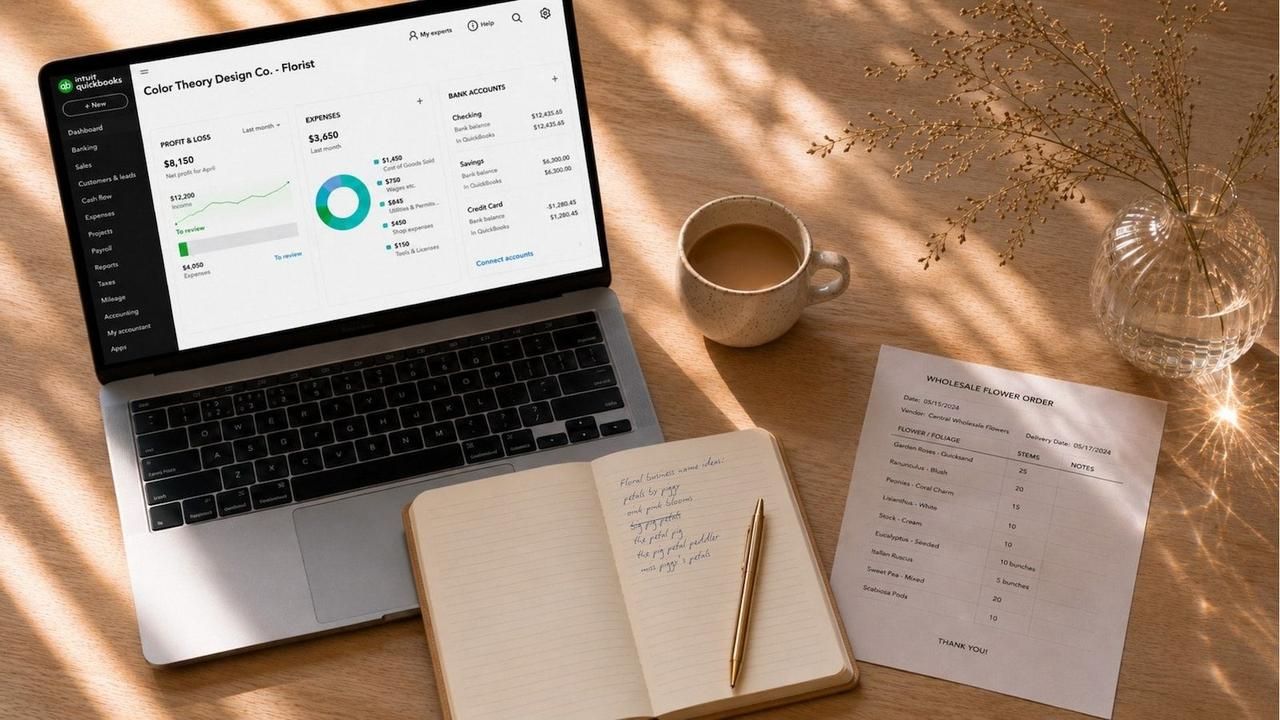
The Complete Floristry Business Starter Checklist
Brian Hummel, Co-Owner | Flowering Minds
This is a comprehensive, step-by-step guide to starting a floral business and becoming a self-employed florist - covering the legal, financial, and operational groundwork required to launch and run such a business properly. Our aim is to help you make sound decisions early in the process. Drawn from our years of experience creating a profitable wedding and event floral design business and building out a brick-and-mortar retail flower shop, it walks through everything from choosing a business structure and registering with the right agencies to setting up your accounting, contracts, and tax compliance. Whether you are starting a wedding floristry business, opening a retail flower shop, or going out on your own as a freelance floral designer, these are the foundational steps to get up and running the right way.
Everything here reflects what we have learned building and running our own floral business, but it is not a substitute for advice tailored to your specific situation. For decisions involving taxes, entity structure, or law, confirm the details with a qualified CPA or attorney in your area. Specific figures, fees, and tax thresholds in this guide reflect the rules at the time of writing and change over time, sometimes more than once in a single year, so always confirm current numbers with primary sources such as IRS.gov or your CPA before acting on them.
Work through this guide in sequence. Each step tends to be a prerequisite for the next.
The Complete Setup Checklist
A quick-reference summary of every step in this guide. Check them off as you go.
- Choose your business name
- Search your business name (SOS, USPTO, Google, domain)
- Find a small business CPA before making entity or tax decisions
- Choose your business entity (sole prop, LLC, or S-Corp)
- Register your entity with your state Secretary of State
- Obtain your EIN from the IRS
- Register a DBA if operating under a name other than your legal entity name
- Obtain required local business licenses and permits
- Open a dedicated business checking account
- Open a dedicated business savings account
- Get a business credit card
- Set up QuickBooks Online and connect your bank feeds
- Understand your sales tax obligations by state
- Set up payroll if you are operating as an S-Corp (Gusto)
- Get the right contracts in place
- Build your website and claim your Google Business Profile
- Set up a professional business email address
- Configure your payment processing (Stripe, Square, QuickBooks Payments)
- Open wholesale vendor accounts
- Establish a recurring bookkeeping routine
- Collect a W-9 from every contractor before the first payment
- File 1099-NECs for all qualifying contractors by January 31
- Get business insurance (general liability at minimum)
- Set up a system for quarterly estimated tax payments
- Organize and store your essential business documents
- Consider federal trademark registration once you are operational
Before You File Anything
Step 1: Choose Your Business Name
The name you choose for your floral business is going to live on your domain, your contracts, your bank accounts, your Google Business Profile, and every invoice you send. It is worth spending time on this before you commit, because changing it later is not just a branding inconvenience. It involves refiling with your state, updating your EIN records, reregistering your domain, and potentially rebranding your entire online presence.
A few practical criteria worth applying before you fall in love with a name:
It should survive geography.
If you intend to grow beyond your current city or state, avoid locking your business identity to a specific location in the name. "Austin Blooms" is fine if you plan to stay in Austin. It becomes a liability if you relocate to Dallas.
It should be searchable.
Generic names like "The Flower Studio" or "Bloom Design" are difficult to rank for in search and nearly impossible to trademark. Something more distinctive, even if it is less immediately descriptive, gives you a better foundation for building search authority over time.
It should have an available domain.
Check this before you do anything else. A name with a clean .com available is meaningfully easier to establish online credibility with than one where you are competing with an existing site at the exact same name.
It should work across platforms.
Check Instagram, Facebook, Pinterest, and any other platform where you plan to maintain a presence. Consistent handles across platforms are a search signal and a professionalism signal.
One practical note: the legal entity name and the operating name do not have to be identical. Color Theory Design Co, LLC is our legal entity. Flowering Minds is the brand our members interact with. In our case, we operate Flowering Minds under the Color Theory Design Co, LLC entity without a separately filed DBA. Whether a DBA is required in your situation depends on your state and county rules and how your bank handles account naming, which we cover in Step 6.
Step 2: Search Your Business Name
Before you file anything or buy a domain, verify that the name you want is actually available. This is a four-part check and all four parts matter.
Your state's Secretary of State database.
Every state maintains a searchable database of registered business entities. A name that is already registered to another business in your state may not be available for you to use, depending on how similar the names are and what entity type is involved. Start here before anything else. The search is free and takes about two minutes.
The USPTO trademark database (TESS).
The state SOS check only tells you whether the name is taken at the state level. A federal trademark is a different matter entirely. A business in another state may have no registered entity in your state but may hold an active federal trademark on the exact name you want, which gives them the right to stop you from using it nationally. Search the Trademark Electronic Search System at USPTO.gov before you commit to a name. Look for both exact matches and close variations.
Google and social media.
A name that clears both the SOS and USPTO databases can still be complicated if an existing business is actively using it online without having formally registered it. Search the name on Google, Instagram, Facebook, and Pinterest. If another florist or small business is actively trading under that name and has an established online presence, you are looking at potential confusion for clients and possible common-law trademark conflicts down the road even without a formal registration.
Domain availability.
Check your preferred domain at a registrar like Namecheap or GoDaddy. The .com extension matters most for credibility and search, though .co and .design are increasingly acceptable in creative industries. If the exact .com is taken, do not work around it with a hyphen or a different extension just to keep the name. Choose a different name. A hyphenated domain is harder to remember, harder to share verbally, and looks like a second choice.
If the name clears all four checks, buy the domain immediately. Domain availability can change, and waiting until after you have filed your entity paperwork to check creates an unnecessary risk of arriving at the domain purchase step to find the name gone.
One additional tip: if you settle on a particular domain extension (.co as an example), it is definitely worth considering the purchase of adjacent domains (.com, .org, .design) at the same time. Owning your business name across every major extension is inexpensive to maintain and lets you redirect all traffic to your primary site. Skip this step and you may find, once your business gains traction, that a domain reseller has already registered the versions you passed on and listed them for hundreds or thousands of dollars. A few dollars a year in renewals now is cheap insurance against a costly buyback later. Consolidating multiple domains bought through the same registrar is a relatively frictionless process, since the registrar's built-in forwarding lets you point each adjacent domain to your primary site with a simple 301 redirect set up in a few clicks, no separate hosting or DNS configuration required.
Step 3: Find a Small Business CPA Before You Go Any Further
Before you make any decisions about entity structure, sales tax, or bookkeeping systems, find a CPA who works specifically with small businesses. Not a national tax preparation chain. Not a generalist who primarily serves individuals. A small business-oriented CPA who can advise on entity choice, help you understand your sales tax obligations in your state, set up a bookkeeping framework that will hold up at tax time, and think proactively about tax strategy rather than simply filing what you hand them.
Establishing this relationship before you dive too far in is one of the more prudent moves you can make. Early on, a good CPA helps you choose the right entity, set up your bookkeeping correctly, understand your sales tax obligations, capture the deductions you are entitled to, and classify any contractors properly, all decisions that are far cheaper to get right the first time than to unwind later. Down the road, once your revenue is stable and strong enough to justify it, that same CPA is who you will turn to for questions like whether an S-Corp election makes sense. That said, we understand the hesitation. Nobody wants to pour money into professionals before a fledgling business has proven it can sustain itself. The reasonable middle ground is an initial consultation rather than a full ongoing engagement, and even one conversation early can save you from missteps that are costly and difficult to reverse.
Many small business CPAs offer that initial consultation at their hourly rate, and some offer it free. Use it to ask about entity structure for your specific income level and business model, your state's sales tax treatment of floral goods and services, what your bookkeeping setup should look like before your first tax filing, and what your quarterly and annual tax obligations will be. The answers will shape several of the steps that follow.
Legal and Entity Setup
Step 4: Choose Your Business Entity
This is the decision with the most significant and longest-lasting financial and legal implications of anything in this guide, which is also why it is the one I am going to be most direct about referring you to a qualified professional for. What I can offer is a working framework for how to think about the choice as a florist specifically.
There are three entity types most florists will choose between:
Sole Proprietorship.
You and the business are legally the same entity. No formation paperwork, no state filing fees, no registered agent. Income flows directly onto your personal tax return on Schedule C. The tradeoff is that there is no legal separation between your personal assets and your business liabilities. If a client sues the business, they are suing you personally.
Limited Liability Company (LLC).
Creates a formal legal separation between you and the business, which is what limits your personal liability exposure to what you have invested in the company rather than everything you personally own. Taxed as a pass-through entity by default (income flows to your personal return), with the option to elect S-Corp tax treatment on top. Filing requirements and annual fees vary by state, but the process is generally straightforward and the cost is modest relative to the protection it provides.
S-Corporation.
Not a standalone entity type, but a tax election that sits on top of an LLC or a C-Corporation. The S-Corp election allows the business to pay owner-operators a W-2 salary and take additional profit as distributions (partner draws), with the distributions not subject to FICA self-employment tax. At sufficient income levels, this produces meaningful tax savings compared to a standard single-member LLC. The tradeoff is added complexity (albeit less complicated than it sounds): payroll, reasonable compensation requirements, and more involved annual tax preparation.
For most florists starting out, an LLC is the right starting point - and what we recommend. It provides the liability protection that a sole proprietorship does not, without the administrative overhead of an S-Corp election. As revenue grows and the tax savings from the S-Corp election start to exceed the cost of maintaining payroll and more complex tax preparation, that is the point at which the S-Corp election is worth revisiting with your CPA.
One important clarification on terminology: an S-Corp is not something you form at the Secretary of State. You form an LLC (or C-Corp), and then you file IRS Form 2553 to elect S-Corp tax treatment. That election has a filing deadline relative to the start of the tax year you want it to apply to, which is another reason to have this conversation with a CPA before year-end rather than after.
This is not legal or tax advice. Entity choice has jurisdiction-specific implications that a qualified CPA or business attorney can evaluate in the context of your specific situation.
Step 5: Register Your Entity with Your State Secretary of State
Once you have chosen your entity type, formation is straightforward. For an LLC, you will file Articles of Organization with your state's Secretary of State office. For a corporation, it is Articles of Incorporation. Both are available online through your state's SOS website, and the filing fee varies by state but is typically in the range of $50 to $500.
A few things worth knowing before you file:
Registered agent.
Most states require you to designate a registered agent: a person or service with a physical address in the state who is authorized to receive legal and government correspondence on behalf of the business. If you have a physical business address in the state, you can often serve as your own registered agent. If you are operating from a home address and prefer not to have it on the public record, registered agent services are available for approximately $50 to $150 per year.
Operating agreement.
Even if your state does not require one for a single-member LLC, draft an operating agreement. This document establishes the ownership structure, how decisions are made, and what happens to the business in the event of an owner's death, disability, or departure. It is also what a bank or lender will want to see when you open a business account or apply for financing. For a single-member LLC, it can be a simple document. For a multi-member LLC, it is essential to have an attorney involved.
Annual reporting and franchise tax.
Most states require LLCs and corporations to file an annual report and pay an associated fee to remain in good standing. In Texas, for example, there is no state income tax but there is a franchise tax, with a filing requirement even for businesses below the tax threshold. Miss it long enough and the state can administratively dissolve your entity. Put the annual due date on your calendar the day you form the entity. Our CPA includes the Texas franchise report filing as part of their annual engagement.
Step 6: Obtain Your EIN from the IRS
An Employer Identification Number (EIN) is the federal tax identification number for your business, the business equivalent of a Social Security Number. You need one before you can open a business bank account, hire employees, put contractors on payroll, or file business taxes as an entity.
The IRS issues EINs for free through an online application at IRS.gov. The process takes approximately ten minutes and your EIN is issued immediately upon completion. There is no cost and no waiting period.
Even if you are operating as a single-member LLC with no employees, I recommend getting an EIN rather than using your Social Security Number as your business tax ID. When a vendor or contractor asks you to complete a W-9, you will be providing your tax ID number. Using an EIN on that form keeps your SSN off documents that may pass through multiple hands.
When your EIN is issued, the IRS will send a confirmation letter (CP 575). Print it and file it somewhere you can find it. Your bank will ask for it when you open your business accounts, and you will need the number on your annual business tax returns. It is one of those documents that feels trivial to keep track of until you need it and cannot locate it.
Step 7: Register a DBA If Needed
A DBA (Doing Business As) allows you to legally operate your business under a name other than the exact legal name of your registered entity. It is also referred to as a fictitious business name, trade name, or assumed name depending on the state.
If your LLC is registered as "Smith Floral LLC" but you operate under the name "Botanica Studio," you need a DBA for "Botanica Studio" in order to open a bank account under that name, accept checks made out to that name, and sign contracts under that name.
DBA registration is handled at the state or county level depending on jurisdiction, with fees typically in the $10 to $100 range. It is not the same as forming a new entity and does not provide any additional liability protection. It simply provides a legal mechanism for operating under a trade name.
If your LLC name and your operating name are identical, you do not need a DBA. If they are different in any way, even punctuation or the inclusion or exclusion of "LLC," check your state's requirements. The bank will ask when you try to open an account under your trade name.
Step 8: Obtain Required Local Business Licenses and Permits for your Floral Business
Business licensing requirements vary significantly by city, county, and state, and there is no single national database that covers all of them. Your Secretary of State registration establishes your entity at the state level. It does not constitute permission to operate a business in your specific city or county.
At minimum, check for the following:
City or county business license.
Most municipalities require a general business license for any business operating within their jurisdiction. The fee is typically modest (often under $100 annually), but operating without one can result in fines and complications when you try to open bank accounts or obtain other permits.
Home occupation permit.
If you are operating your floral business from a home studio, your city may require a home occupation permit in addition to a general business license. Some residential zones have restrictions on the types of business activity permitted, the volume of client traffic, signage, and delivery vehicles. Check your local zoning ordinances before you begin operating from a home address.
Seller's permit or sales tax permit.
If you are selling taxable goods (which, for most florists, includes floral arrangements and hard goods), your state will require you to register for a seller's permit before you collect and remit sales tax. This is separate from your EIN and your entity registration. We will cover the mechanics of sales tax in Step 11, but the permit registration needs to happen before you make your first taxable sale.
The SBA's Business License and Permits tool is a reasonable starting point for identifying what applies in your state and municipality, though I would always verify directly with your city and county offices rather than relying solely on an aggregator.
Financial Infrastructure
Step 9: Open Your Business Bank Accounts and a Business Credit Card
This step needs to happen before you take a single dollar of revenue or spend a dollar on the business. I want to be direct about why, because it is the step I see florists most commonly skip or defer and then regret.
The liability protection your LLC provides is contingent on actually operating like two separate financial parties. If you are running business transactions through your personal checking account, you are commingling funds, and commingling is one of the primary grounds on which courts disregard the legal separation between an owner and their LLC, a doctrine known as piercing the corporate veil. The entity structure you paid to form and maintain exists to limit your personal liability. Commingled finances undermine it.
Beyond the legal argument, there is a practical one: you cannot produce an accurate Profit and Loss statement, a credible tax return, or a meaningful set of financial records if business and personal transactions are mixed in the same account. Every bookkeeping session becomes an exercise in reconstruction rather than reporting.
Here is the specific setup that works well for a floral business:
Business checking account.
This is the operating account. All business revenue is deposited here. All business expenses are paid from here, including business credit card balances. Every wholesale order, every supply purchase, every software subscription, every vendor payment comes from this account. Nothing personal touches it.
Business savings account.
This account serves as your operating reserve and a staging area for owner distributions. Use it to build a cash cushion against slow seasons, hold funds earmarked for upcoming large expenses, and park owner distributions before transferring them to your personal account. It keeps your checking balance from presenting a misleadingly healthy picture of what is actually available.
A note on taxes that is worth understanding clearly, because it catches a lot of florists off guard in their first year: if you are operating as a sole proprietorship or a single-member LLC without an S-Corp election, no taxes are being withheld from your business income. You are responsible for making quarterly estimated tax payments to the IRS yourself, from your personal funds, four times per year. These are personal payments (Form 1040-ES) sent directly to the IRS, not business transactions. The practical implication is that a percentage of every dollar the business earns needs to find its way to your personal savings before you spend it, because the IRS bill is coming whether or not you planned for it.
In your first year of business, estimating what you owe each quarter requires your best calculation of your expected annual income and tax liability, since you have no prior year to reference. In subsequent years, you can follow safe harbor guidance: pay at least 100% of your prior year's total tax liability (or 110% if your prior year adjusted gross income exceeded $150,000), divided across four equal quarterly payments, and you will avoid underpayment penalties regardless of what you ultimately owe at filing. Your CPA can help you calculate the right quarterly payment amount once you have a first year of returns behind you.
There is a second safe harbor option worth knowing about, especially in a down year. Instead of paying based on your prior year, you can avoid penalties by paying 90% of your current year's actual tax liability. This matters when revenue drops significantly: basing your payments on a high prior year could mean overpaying substantially against a much lower current liability, leaving your cash parked with the IRS until refund time. Reliable QuickBooks reporting lets you project current-year income accurately enough to use the 90%-of-current-year option with confidence. As always, run the calculation with your CPA, but it starts with books current enough to trust the numbers.
S-Corp owners have a different dynamic. Gusto handles W-2 payroll by debiting your business checking account to fund each payroll run, remitting the withheld federal and state income taxes, and depositing the employee and employer FICA contributions on the IRS-required schedule. Those funds leave the business account as a payroll expense. Any additional estimated tax payments you owe beyond what withholding covers are a separate personal transaction, paid from your personal bank account to the IRS directly via Form 1040-ES. The withholding component is a business transaction. The estimated payment component is a personal one.
Business credit card.
A dedicated business credit card serves two functions. First, it provides a clean record of business expenses that is entirely separate from personal spending. Second, it builds business credit history, which matters if you ever need a line of credit, equipment financing, or an SBA loan. Use it for recurring business expenses: wholesale orders, supply purchases, software subscriptions, fuel for deliveries. Pay it monthly from the business checking account.
Step 10: Set Up QuickBooks Online
With your bank accounts open and connected, QuickBooks Online becomes the financial nervous system of the business. Every dollar in and every dollar out flows through it, gets categorized, and becomes part of a set of financial records that your CPA can work with, your lender can evaluate, and you can actually use to make decisions.
I want to be specific about what QuickBooks does and does not do, because the expectation gap is where most florists get frustrated with it. QuickBooks does not manage your flower inventory at the stem level. It does not tell you how to price an arrangement. What it does is track the financial result of every business transaction with enough structure that you can look at any month, quarter, or year and know exactly what came in, what went out, what it cost to deliver your work, and what was left over. That clarity is what makes pricing decisions, hiring decisions, and growth decisions something other than guesswork.
Setting up your chart of accounts for a floral business.
QuickBooks ships with a generic chart of accounts, and it is worth putting real thought into customizing it before you start categorizing transactions. A well-organized chart of accounts, with each account assigned the proper account type and detail type, is what makes your reports actually useful later. The goal is categories that reflect how your business genuinely operates, not a pile of transactions dumped into "Miscellaneous," where financial clarity goes to disappear.
The most important concept for florists to understand here is Cost of Goods Sold (COGS). It is intuitive to assume that the flowers and supplies you buy are simply expenses. But when you purchase flowers, containers, and floral supplies to fulfill a client order or event, those costs are not general operating expenses, they are the direct cost of producing what you sold, and they belong in COGS. Tracking them there rather than lumping them in with rent and software is what lets you see your true gross margin on an arrangement or event: what you actually made after the cost of the materials that went into it. Wholesale flowers, hard goods and containers, and consumable floral supplies (foam, wire, tape, ribbon) are all natural COGS categories.
The key is that COGS is about purpose, not the item itself. The same stems can land in different categories depending on why you bought them. Flowers that go into a paid client order are COGS. The same flowers bought to shoot social media content, build your portfolio, or create advertising imagery are a marketing expense, not COGS, because they were never sold to a client. A styled shoot you produce to attract bookings is marketing. A donated arrangement for a charity event is either marketing or a charitable contribution depending on how it is handled. The physical product is identical; the tax and financial treatment depends entirely on where it ended up.
A few other categorization situations commonly trip florists up:
Personal draws are not an expense. When you pay yourself as a sole proprietor or single-member LLC, that money is an owner's draw, not a business expense. It does not reduce your taxable income and should never be categorized as one. Miscategorizing draws as expenses is one of the more common ways florists accidentally misstate their profit.
Sales tax collected is not income. The sales tax you collect from clients is not your money and not revenue. It is a liability you are holding on behalf of the state until you remit it. It needs to be tracked as a liability, not deposited into your income, or your books will overstate what you actually earned.
Client deposits: know how your accounting method treats them. Most new florists operate on a cash basis, which means a deposit or retainer is generally counted as income the moment you receive it, even if the event is months away. That is straightforward, but it has a cash-flow consequence worth understanding: a large deposit collected in December for a June wedding counts as income in the year you received it, which can affect that year's tax picture. If you elect accrual accounting instead, that same deposit is treated as a liability (unearned revenue) until you actually deliver the event. Know which method you are on, because it changes both when you owe tax on the money and how your books reflect it.
Mileage versus actual vehicle expenses is an either/or choice. You can deduct business mileage at the standard IRS rate, or you can deduct actual vehicle expenses (gas, maintenance, depreciation), but not both for the same vehicle. Tracking both in QuickBooks without understanding you must choose one method at tax time leads to confusion and, potentially, an incorrect return.
Equipment purchases may be assets, not expenses. A large purchase like a commercial cooler, a delivery vehicle, or a significant equipment investment is generally a capital asset that gets depreciated over time, not a one-time expense in the month you bought it. How this is handled affects your deductions and should be set up with your CPA.
Everything else: your rent, delivery costs, marketing, insurance, software, and professional services, lives under operating expenses (ordinary, ongoing costs of running the business). Exactly how you structure all of this is a good conversation to have with your CPA, since every floral business runs a little differently and several of these categories carry real tax consequences. But the guiding principle holds: the more precisely your categories reflect your actual operations, the more your reports, and your tax filings, will reflect reality.
Tracking mileage the right way.
If you take the standard mileage deduction, the IRS requires a contemporaneous mileage log, and automatic tracking apps make that painless by using your phone's location to record trips in the background. QuickBooks has mileage tracking built into its mobile app, which keeps the record in the same system as your books; standalone options like MileIQ, Everlance, and Stride do the same thing if you prefer a dedicated tool. The standard mileage rate itself is set by the IRS and changes periodically, sometimes more than once in a single year (verify the current rate for your tax year), so let the app apply the correct rate rather than hardcoding one.
The rule that trips up the most florists is the line between deductible business miles and non-deductible commuting. Driving from home to your regular place of work, and back home at the end of the day, is commuting, and commuting is never deductible, no matter the distance and even if your car is full of flowers and supplies. For a retail shop owner, the shop is that regular workplace. For a freelance designer or event florist whose home studio genuinely qualifies as their principal place of business, the rule works in your favor: trips from the home studio to a venue, client, or the flower market count as business miles from the moment you leave.
What counts as a business mile:
- Shop to a wedding venue to install, then back to the shop
- Shop to the wholesale market for a restock, then back
- Shop to a client consultation, a delivery, or the post office to ship an order
- Between two event sites on the same day
- Home studio to a client or venue, if your home studio qualifies as your principal place of business
What does not count:
- Home to your retail shop to start the day, and home again at close (this is commuting)
- Home to the shop with a stop at the supply store on the way (a personal-side stop does not convert a commute)
- The personal leg of a mixed trip, such as extending a delivery run to pick up your dry cleaning (only the business leg counts)
- A commute you happen to drive with product in the car or while taking a work call (neither changes the classification)
The most common and costly mistake is treating a routine commute as business mileage because you happened to carry product or take a work call during the drive. Neither changes the classification. As with everything tax-related, confirm the specifics with your CPA, since the home-office qualification in particular has its own requirements.
Connecting your bank feeds.
Once your accounts are categorized, connect your business checking, savings, and credit card accounts to QuickBooks. Transactions will import automatically, usually within one business day of posting. QuickBooks learns your categorization patterns over time (you can also set up rules), so a wholesale order from your primary supplier will eventually be auto-categorized without manual intervention. The first few weeks of categorizing transactions are the most time-consuming part of the setup. It gets significantly faster after that.
Snap receipts as you go.
The QuickBooks mobile app lets you photograph a receipt and attach it directly to a transaction, pulling the vendor, date, and amount automatically. For a business where you are constantly buying flowers and supplies, often on the move, building the habit of snapping each receipt at the point of purchase saves hours of reconstruction later and gives you documentation that holds up if you are ever audited. A shoebox of faded thermal-paper receipts is not a record-keeping system; a photographed receipt attached to its transaction is.
Connecting with your CPA.
QuickBooks allows you to grant accountant access directly from your account settings. This means your CPA can log in, pull whatever reports they need for tax preparation, and identify any categorization issues without you needing to export spreadsheets or reconstruct the year's activity from bank statements. If your CPA is not familiar with QuickBooks, that is worth factoring into your evaluation of whether they are the right fit for a business at your stage.
Reports worth running monthly.
The Profit and Loss report is the one to look at every month without exception. It tells you whether the business made money in a given period, which categories are growing or shrinking, and where your margins are relative to your revenue. The Cash Flow Statement tells you whether cash is actually moving through the business in a healthy pattern, which matters especially during the off-season months that follow a high-volume wedding season. The Accounts Receivable Aging report tells you who owes you money and how long it has been outstanding, which is particularly relevant for wedding florists managing deposit schedules across multiple events.
A note on floristry-specific software.
QuickBooks handles accounting, bookkeeping, and financial reporting. It can generate invoices and estimates, and many florists use it for exactly that. But depending on your business model, you may find that a more specialized tool fits between your clients and your books.
For wedding and event florists, the industry-standard proposal and workflow platforms are Details Flowers, Curate, and True Client Pro. All three are built specifically for event florists and handle proposals, mood boards, floral recipes, contracts, client portals, and payment collection in a single workflow. HoneyBook is a broader creative business platform (not floristry-specific) that handles similar client-facing workflow and is widely used by independent florists who want an approachable, affordable starting point.
For retail florists with a physical shop, dedicated floristry POS systems include FloristWare, Hana POS, QuickFlora, and FloraNext. These are purpose-built for flower shop operations: wire service integration, delivery routing, same-day order management, customer CRM, and inventory that accounts for the perishable nature of what you are selling.
If you are just starting out and not yet ready to invest in specialized software, a well-organized spreadsheet approach is a legitimate starting point. A structured workbook covering client inquiries, event details, recipe costing, and invoicing can carry a new florist through early-stage growth before the volume justifies a platform subscription. For a practical florist planning toolkit built for exactly this stage, we recommend this resource from Kristine Aejin: The Ultimate Florist's Planner.
This is a startup guide, so we are not going to get into the specifics of each platform here. The point is that your technology stack will likely involve QuickBooks as the financial backbone plus one or more of the above depending on your business model. Do not try to make QuickBooks do everything.
[Affiliate disclosure: Flowering Minds may earn a commission if you sign up for QuickBooks through links on this site, at no additional cost to you. We only recommend tools we actually use in our own business.]
Step 11: Understand Your Sales Tax Obligations as a Florist
Sales tax is the step most florists underestimate, and the one most likely to create retroactive liability if it is handled incorrectly from the start. I am going to be direct: this section warrants a conversation with a CPA who is familiar with your state's rules before you make any decisions, because the variation by state is significant and the consequences of getting it wrong are not.
Here is the framework for understanding what you are dealing with:
Physical nexus vs. economic nexus.
You have an obligation to collect and remit sales tax in any state where you have nexus, which is a legal threshold of connection to that state. Physical nexus exists where you have a physical presence: a studio, a shop, an employee, even a significant amount of inventory stored in a warehouse. Economic nexus is the more recent development: following the Supreme Court's 2018 South Dakota v. Wayfair decision, most states now impose sales tax obligations on out-of-state sellers who exceed certain revenue or transaction thresholds in that state, regardless of physical presence. For an online florist educator selling digital memberships or downloads, this is not hypothetical.
How states treat floral arrangements differently.
Fresh flowers, dried flowers, hard goods, design fees, and delivery charges can be taxed entirely differently within the same state, and what is taxable in one state may be exempt in another. Some states tax floral arrangements as tangible personal property. Some exempt fresh-cut flowers. Some tax delivery separately. Some bundle the entire transaction. Do not assume that what applies to you in your home state applies anywhere you are selling.
Where to configure sales tax collection.
If you are selling through Squarespace, Stripe, or QuickBooks Payments, each of these platforms has a mechanism for configuring sales tax collection by state. QuickBooks has a built-in Sales Tax Center that can calculate, track, and help you prepare remittance for each state where you have an obligation. Stripe Tax is a separate add-on that automates this at the payment level. Neither platform replaces the need to understand your obligations first. They are tools for executing a compliance strategy, not for determining what that strategy should be.
Register before you collect.
You need a seller's permit or sales tax permit from each state where you have a collection obligation before you begin collecting tax. Collecting sales tax without a permit, or failing to collect it when you should, both create liability. The registration process is typically handled through the state's department of revenue website and is, in most cases, free.
Resale certificates: buying without paying tax twice
Once you have your seller's permit, most states let you use that same registration to obtain a resale certificate. A resale certificate is what you provide to your wholesale vendors so they do not charge you sales tax on flowers and hard goods you are buying to resell. Without one on file, a wholesale vendor is required to charge you sales tax on the purchase. You are still required to collect sales tax from your customer when you sell the arrangement, so skipping the certificate means the same flowers get taxed twice: once at wholesale, once at retail, instead of only once at the final sale where sales tax is actually meant to apply. Most wholesale vendors will not open an account without this certificate on file, which I cover using Mayesh as an example in Step 16.
Step 12: Set Up Payroll If You Are Operating as an S-Corp
This step applies only if you have elected S-Corp tax treatment for your business. If you are operating as a standard single-member LLC, you can skip to Step 13 for now and return here when you revisit the S-Corp election with your CPA.
For S-Corp owners who are active in the business: the IRS requires that you pay yourself a reasonable W-2 salary before taking any profit distributions. This is not optional and it is not a gray area. The reasonable compensation requirement exists because the tax advantage of an S-Corp (distributions not subject to self-employment tax) would otherwise create an obvious incentive to pay yourself zero salary and take everything as distributions. The IRS is aware of this incentive and audits S-Corps with suspiciously low owner salaries. What constitutes reasonable compensation is based on what you would pay someone else to perform the same work, which in practice for a florist-educator means researching comparable salaries for creative directors, educators, or business operators in your area and documenting your rationale.
Why Gusto.
Payroll for a small S-Corp owner involves federal income tax withholding, Social Security and Medicare (FICA) withholding on the employee side, matching FICA contributions on the employer side, federal unemployment tax (FUTA), state income tax withholding where applicable, and state unemployment tax where applicable. Each of these has its own deposit schedule and filing deadline. Gusto handles all of it: calculates the withholding, deposits the taxes on the required schedule, files the quarterly 941s and annual 940, and issues W-2s at year-end. It also integrates directly with QuickBooks, so payroll transactions flow into your books automatically without manual journal entries.
Gusto can also handle benefits alongside payroll, and how you approach this comes down to preference and cost. Gusto can fully administer benefits like retirement contributions and health insurance, deducting them from payroll and remitting them to the provider for you, but it charges a service fee for that convenience. Alternatively, you can have Gusto simply record the amounts for accurate W-2 reporting and post the corresponding liabilities into QuickBooks, then make the payments to the retirement plan provider or insurance carrier yourself and avoid the fee. Either way the withholding and W-2 documentation are correct. The only question is whether you would rather pay for the hands-off convenience or handle the remittance yourself for free.
The alternative to a payroll service is doing this manually or hiring a payroll accountant. For the vast majority of small floral businesses running a single-owner S-Corp payroll, Gusto is meaningfully more efficient than either alternative.
[Affiliate disclosure: Flowering Minds may earn a commission if you sign up for Gusto through links on this site, at no additional cost to you.]
Step 13: Get the Right Contracts in Place
Running a floral business without contracts is not an act of trust. It is an assumption that nothing will ever go wrong, which is a position that a single difficult client, a weather event, a vendor failure, or a global pandemic can make very expensive very quickly. Contracts exist to establish shared expectations before a problem occurs, not to signal distrust of your clients.
There are four categories of contracts a floral business needs:
Client contract for weddings and events.
This is the most consequential document in your business. It should cover at minimum: the event date and scope of work, the total fee and payment schedule, your retainer policy and whether any fees are refundable, your cancellation and rescheduling terms (including who bears the cost of flowers already ordered), a flower substitution clause for availability and market variations, your delivery and setup scope and any overtime provisions, and a force majeure clause. The force majeure clause is the one that covers events beyond either party's control, and it is the one that florists discovered they desperately needed in 2020.
Independent contractor agreement.
If you hire freelance designers, day-of assistants, or delivery drivers for individual events, each one should have a signed independent contractor agreement before they work their first event with you. The agreement should define the scope of work, the payment rate and timing, the fact that they are responsible for their own taxes (and that you will file a 1099-NEC if they exceed the threshold), confidentiality provisions if relevant, and ownership of any work product. This document is also part of what supports the independent contractor classification itself, which we will address in the 1099 section.
Privacy policy and cookie policy for your website.
If your website collects visitor data (through a contact form, a payment processor, Google Analytics, or Meta Pixel), you are legally required to have a privacy policy in most jurisdictions. If you run Meta or Google ads, both platforms require it as a condition of running campaigns. A cookie policy or cookie consent banner is required under GDPR for European visitors and under CCPA for California residents. These are not optional documents for a business with any online presence, and a generic template from a random website generator is not an adequate substitute for a policy that actually reflects how your business collects and uses data.
General terms and conditions.
For retail transactions, non-event orders, and any sale not covered by a specific event contract, a general terms and conditions document establishes your return policy, your substitution policy, your liability limitations, and your payment terms.
A few contract lessons from our own experience. We are not attorneys, and nothing here is legal advice, but these are considerations that came up repeatedly over our years of booking events. Each is worth raising with your own legal counsel for your specific situation.
- Sign in the name of your business, not yourself. Contracts should be executed on behalf of the entity, for example "Color Theory Design Co, LLC by Brian Hummel, Owner," rather than in your personal name. Signing personally can undercut the liability protection your entity was formed to provide.
- Understand deposit versus retainer. The specific term you use for a non-refundable booking fee can carry different legal weight. A "deposit" may be interpreted as refundable until services are rendered, while a "retainer" is generally understood as earned the moment you agree to hold a client's date. We were advised to use retainer for this reason. Confirm the right language in your jurisdiction.
- Keep a non-refundable retainer fixed, not percentage-based. A retainer is more defensible as reasonable when it is a consistent, fixed amount across comparable bookings rather than a percentage of the client's floral budget, because what you are really selling is your reserved availability on a specific date, which does not change with the size of their order.
- Treat a booked date as limited inventory. When you reserve a date, you take it off the market and forgo every other booking for that slot. This is the underlying logic behind both a non-refundable retainer and a rescheduling fee: a reschedule is effectively the sale of a new date while the original date goes unfilled, along with the administrative work and the opportunity cost of giving up another prime booking. A reasonable rescheduling fee reflects that real loss.
- Take your force majeure clause seriously. This clause addresses events beyond either party's control, such as public health emergencies. The events of 2020 made clear how essential it is and how specific it needs to be.
For all of these, I would direct you to The Legal Paige (be sure to use code FLOWER10 for a 10% discount), which offers contract templates drafted specifically for creative businesses including florists. These are strong enough to use as-is for most standard situations. Refine each one against any edge cases particular to your own business model, then have local legal counsel review it before you rely on it. A solid template plus an attorney who knows your state's requirements is what makes a contract bulletproof.
Build Your Business Operations
Step 14: Build Your Website and Claim Your Google Business Profile
Your website is where you control your own narrative, your pricing presentation, your booking flow, and your brand identity. Every other platform (Instagram, The Knot, Yelp, Google) is rented ground. You are subject to their algorithm changes, their terms of service, and their decision about how prominently to feature your business on any given day. Your website is the one digital property you own outright.
Choosing a website platform.
For most florists, the decision comes down to a small number of platforms:
Squarespace is the platform I would recommend for the majority of floral businesses. The design quality is consistently high without requiring design expertise, the e-commerce functionality is solid, the built-in SEO tools are functional, and the all-in-one hosting and domain management is genuinely convenient. It is what colortheorydesign.co is built on.
Showit has developed a strong following among wedding photographers and is increasingly used by wedding florists. It offers more design flexibility than Squarespace and pairs with WordPress for blogging, which gives you the benefit of WordPress's content management and SEO capabilities without building the entire site in WordPress. The tradeoff is a steeper learning curve and a higher monthly cost.
WordPress remains the most powerful and flexible option and the platform with the most robust SEO tooling (particularly with Yoast or Rank Math). It requires separate hosting (SiteGround and WP Engine are both reliable), more technical maintenance, and meaningfully more setup time than Squarespace or Showit. For a florist who wants to invest heavily in content marketing and SEO over the long term, it is worth the learning curve. For most florists, it is more platform than the use case requires.
Shopify is optimized for e-commerce at scale. If your primary revenue model is retail flower sales or shipped product, it is worth considering. For an event or education-focused floral business, it is more infrastructure than you need.
Whatever platform you choose, your website needs at minimum: a clear description of your services and service area, a contact form or booking inquiry flow, your cancellation and retainer policies, a privacy policy and cookie policy (see Step 13), and some demonstration of your work.
Claim your Google Business Profile immediately.
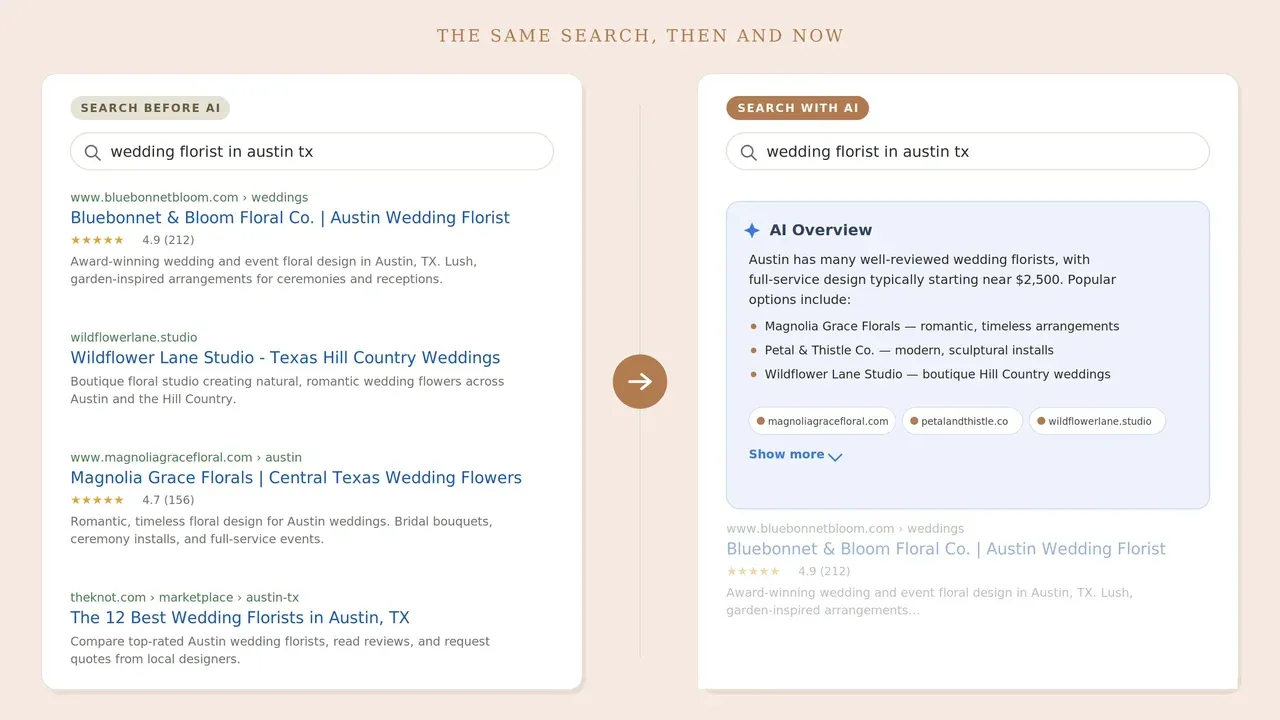
Google Business Profile (formerly Google My Business) is a free listing that controls how your business appears in Google Maps and in the local results that appear when someone searches for florists in your area. It is frequently the first thing a potential local client finds before they ever reach your website. Claim it, verify it, fill out every field (business hours, service area, categories, photos), and actively maintain it. Reviews left on your Google Business Profile are a direct local ranking signal.
Claim your social media handles, even the ones you will not use yet.
Back in Step 2 you checked handle availability across platforms. Now claim them. Register your business name on Instagram, Facebook, Pinterest, TikTok, and any other platform you expect to use, and consider claiming it on the ones you do not plan to use as well. This is the same defensive logic as buying adjacent domains: it costs nothing to reserve your name and prevents someone else from taking it or impersonating your business later. Consistent handles across platforms are also a small trust and search signal. You do not need to post everywhere from day one, but you should own your name everywhere.
Turn on data collection from day one.
Set up Google Search Console and Google Analytics when your website launches, even if you are not ready to analyze the data yet. Both are free. The reason to do this early is simple: neither tool can show you data from before it was installed. Every week you operate without them is a week of search and visitor data you can never recover. Connect them at launch, let them quietly collect, and learn to use them when you are ready. Understanding what those numbers mean and how to act on them is a topic for another day, but the data collection needs to start now.
Get a professional business email address.
A floral business operating from a Gmail, Yahoo, or iCloud address is sending an unintentional signal that it is either very new or not particularly serious. A branded email address at your domain ([email protected]) costs approximately $6 to $12 per month through Google Workspace and is one of the lowest-cost credibility investments available. It also matters operationally: your contracts, invoices, vendor accounts, and client communication should all run through an address tied to your domain, not a personal account. If you ever sell the business, a personal email address tied to client relationships is a transfer complication. A domain-based address is not.
Step 15: Set Up Payment Processing
Florists need to be able to accept credit cards. Cash and check are not a viable primary payment method for a business that charges event deposits, issues invoices, and needs reliable documentation of every transaction.
Stripe is the payment processor I would start with for most floral businesses, particularly those operating a website as their primary point of sale. Stripe integrates natively with Squarespace and handles both one-time and recurring billing. The transaction fees are competitive (2.9% + $0.30 per transaction for standard card processing), the documentation is excellent, and the fraud detection is strong. Stripe also offers Stripe Tax, which can automate sales tax calculation at the transaction level for businesses with multi-state obligations.
Square is the better choice for florists with a retail or in-person component: a flower shop, a farmers market booth, a pop-up. Square's free card reader and point-of-sale system are purpose-built for in-person transactions, and the reporting is straightforward. For a purely event-based or online business, it is more than you need.
QuickBooks Payments is worth considering if you want your invoicing, payment processing, and accounting in a single system. Clients can pay directly from an emailed QuickBooks invoice, and the payment records directly in your books without manual entry. The transaction fees are comparable to Stripe.
One important note on deposits: your payment processor is not your contract. A client who disputes a deposit charge with their credit card issuer can initiate a chargeback, and without a signed contract clearly establishing the non-refundable nature of the deposit, those disputes are difficult to win. Get the contract signed before you take the deposit payment, not after.
Step 16: Open Wholesale Flower Vendor Accounts
Buying flowers at retail prices from a grocery store or a big-box retailer is not a sustainable model for a floral business of any meaningful size. Trade pricing from wholesale vendors requires establishing a wholesale account, which typically requires a business license, a resale certificate (a separate document from your seller's permit, though you will use your Step 11 registration to obtain it), and in some cases proof of entity registration.
Mayesh Wholesale Florist operates locations across the United States and is one of the most accessible wholesale options for florists outside of major metropolitan markets, with both in-person locations and an online ordering platform. It will not approve a wholesale account without a copy of your resale certificate on file, since it needs that document to justify not collecting sales tax on your purchases. Have it ready before you apply, since an incomplete application over a missing certificate is one of the more common reasons approval gets delayed. Accent Decor handles hard goods, containers, and specialty items. Your local flower market, if one exists in your area, will typically have the best pricing on high-volume perishables.
Getting these accounts established before you have a large event on the books is worth doing. The account approval process takes time, and discovering that you need to open a wholesale account the week before a large wedding is not when you want to be doing administrative paperwork.
Contractor and Tax Compliance
Step 17: Collect a W-9 from Every Contractor Before the First Payment
If you hire freelance designers, day-of assistants, or delivery drivers as independent contractors, you need a completed W-9 form from each of them before you pay them for the first time. Not after the first event. Not at the end of the year when you realize you need to file a 1099-NEC. Before.
The W-9 collects the contractor's legal name, business name if applicable, tax classification, and taxpayer identification number (either their SSN or EIN). Without it, you do not have the information you need to file a 1099-NEC if their annual earnings reach the reporting threshold (verify the current figure for your tax year), and the IRS technically requires you to apply 24% backup withholding on payments to contractors who have not provided a valid TIN. Practically speaking, most small floral businesses do not enforce backup withholding on uncompliant contractors, but the resulting failure to file a 1099-NEC when required is a separate problem.
The practical failure mode I have seen repeatedly: a florist pays a day-of assistant for several events throughout the year, the total crosses the reporting threshold, January arrives, and the florist discovers they do not have the assistant's address, legal name, or TIN. The assistant has changed their phone number. The florist now has a filing deadline, no information, and a contractor who is not responding. Getting the W-9 before the first check eliminates this entirely.
Store the completed W-9s somewhere organized and accessible. You will need them in January.
Step 18: File 1099-NECs for Qualifying Contractors
If you paid any independent contractor at or above the annual reporting threshold during the calendar year, you are required to file a 1099-NEC (Nonemployee Compensation) reporting that payment to both the contractor and the IRS. That threshold changed recently: for 2025 payments it was $600, and for payments made in 2026 and later it rose to $2,000 (under the One Big Beautiful Bill Act passed in 2025). Beginning in 2027 the $2,000 figure is indexed to inflation and adjusted annually, so the exact number will change from year to year (verify the current figure for your tax year). When in doubt, collect a W-9 and track payments regardless of amount, since the income is taxable to the contractor whether or not a form is required. The filing deadline is January 31 of the following year.
QuickBooks can generate and electronically file 1099-NECs if the contractor's W-9 information is entered in the system and their payments are properly categorized. This is the most efficient path for florists already on QuickBooks. If you prefer to handle it outside of QuickBooks, third-party services like 1099tax.com and Track1099 offer e-filing at a modest per-form cost.
One clarification worth making about PayPal and Venmo: payment platforms now issue their own 1099-Ks to contractors who receive above certain thresholds through those platforms. This does not eliminate your obligation to file a 1099-NEC if the reporting threshold is met. The 1099-K reports payment platform activity to the contractor. The 1099-NEC reports what you paid them to both the contractor and the IRS. They serve different purposes and the IRS expects both where both apply.
A critical note on independent contractor vs. employee classification.
Calling someone an independent contractor in your agreement does not make them one according to the IRS. The IRS applies a multi-factor test centered on three categories: behavioral control (do you control how and when the worker does their job), financial control (do you control how the worker is paid, whether expenses are reimbursed, who provides tools), and the type of relationship (is there a written contract, are there employee benefits, is the work a key aspect of your regular business). A freelance designer who works every weekend at your direction, uses your tools and supplies, follows your schedule, and has no other clients looks a lot like an employee regardless of what the contract says. The consequence of misclassifying an employee as an independent contractor is back payroll taxes covering both the employer and employee portions of FICA, plus penalties and interest. State labor agencies run parallel enforcement and penalties stack. If you have any doubt about how a working relationship should be classified, ask your CPA before the first payment, not after an audit letter arrives. We will cover contractor classification in depth in a dedicated post in this series.
Step 19: Get Business Insurance
The entity structure you formed in Step 4 provides legal separation between your personal assets and your business liabilities. Insurance is what protects the business assets themselves when something goes wrong. The two are complementary, not redundant, and most florists need both.
General liability insurance.
This is the minimum coverage a floral business should carry. It covers third-party claims for bodily injury and property damage arising from your business operations. A guest at a wedding who trips over a floral installation. A client whose tablecloth is damaged during setup. A vase that falls and breaks something expensive. These are the everyday risk scenarios that general liability is designed to address.
Product liability.
Closely related to general liability and often bundled with it. For florists specifically, it covers claims arising from the products you sell or use: an allergic reaction to a flower variety used in an arrangement, foam or floral wire that causes an injury, a structural element of a large installation that fails. If you use any product that a client or guest comes into contact with, product liability coverage matters.
Commercial property insurance.
Covers your business property: studio equipment, coolers, vases, props, tools, and inventory. Your personal homeowner's or renter's policy almost certainly excludes business property above a very low threshold. If you have equipment or inventory of meaningful value stored in a home studio, verify your coverage and fill the gap with a business policy or endorsement if needed.
Event cancellation insurance.
A separate product that covers financial losses resulting from an event being cancelled or postponed due to circumstances outside your control. It is not a standard part of a general liability policy. Some wedding florists carry it as protection against scenarios where a cancelled event results in non-recoverable costs for flowers already ordered or labor already contracted. It became considerably more relevant to the wedding industry after 2020.
Rental vehicles and additional insured requirements.
If you rent trucks for large deliveries or installations, the rental company will require proof of insurance and in most cases will ask to be named as an additional insured on your policy, or will require you to show a certificate of insurance listing them as a certificate holder. Confirm with your insurance provider before your first large rental that your policy covers business use of rented vehicles and that they can issue a certificate of insurance naming a rental company when needed. Some rental companies also offer their own damage waivers, which may or may not duplicate coverage you already carry. Establish a vendor account with your preferred rental company early so that process is not something you are figuring out the week before a large installation.
Ongoing Responsibilities
Step 20: Establish a Recurring Bookkeeping Routine
Setting up QuickBooks is a one-time task. Keeping it accurate is an ongoing one, and the florists I have seen struggle with their finances are almost never struggling because of a software problem. They are struggling because they set up the software and then let the transaction feed go uncategorized for three months until it became an overwhelming backlog rather than a ten-minute weekly task.
The routine that works is simple and does not require dedicated accounting expertise to maintain:
Weekly (approximately 10-15 minutes). Log into QuickBooks and categorize any uncategorized transactions from the bank feed. Match any payments received against open invoices. Flag anything you are unsure how to categorize so you can address it with your CPA at your next check-in rather than guessing and creating a problem to untangle later.
Monthly (approximately 30-60 minutes). Reconcile your checking, savings, and credit card accounts against your bank statements. Run your Profit and Loss report for the month and actually read it. Compare it to the prior month and to the same month in the prior year if you have the history. Note anything that looks unusual. Review your Accounts Receivable Aging report and follow up on anything overdue.
Quarterly. Review your COGS margins by event type or product category. If you are profitable on weddings but losing money on retail, that is information worth having before you take on another season of retail commitments. This is also when you review your personal tax situation with your CPA and confirm whether your withholding or estimated payments are on track.
Annually. Reconcile fully before handing anything to your CPA. Issue 1099-NECs by January 31. Review your insurance coverage for the coming year. Revisit your pricing in light of the actual COGS and margin data from QuickBooks.
The discipline of this routine is what transforms QuickBooks from a tax preparation tool into an actual management tool. The data is only useful if it is current.
Step 21: Organize and Store Your Essential Business Documents
The document management question feels administrative and low-stakes until you need something you cannot find. A bank loan application, an audit, a dispute with a vendor, a business sale: every one of these scenarios requires producing documents quickly and accurately. Discovering that your EIN letter, operating agreement, or original Articles of Organization are somewhere in an email inbox from three years ago is not the position you want to be in.
The documents worth organizing and storing from day one:
Government-issued documents: IRS EIN confirmation letter (CP 575), Articles of Organization or Incorporation from your Secretary of State, any state or local business license certificates, your seller's permit, and any DBA registration certificates.
Entity documents: Your operating agreement, any amendments to it, and if you have a multi-member entity, your buy-sell agreement.
Financial records: Annual tax returns (business and personal), QuickBooks account files or exported reports for each year, bank statements for the preceding three years at minimum.
Contractor records: Completed W-9s for every contractor you have paid, organized by year. Copies of all filed 1099-NECs.
Contracts: Signed copies of every client contract, every independent contractor agreement, and your vendor agreements. Organized by year and by client or contractor name.
Insurance: Current certificates of insurance and policy documents.
The storage system itself does not need to be elaborate. A well-organized Google Drive folder structure with consistent naming conventions is entirely adequate. What matters is that every document has a designated location, that you put it there when it is created rather than meaning to organize it later, and that someone other than you could find a specific document if they needed to. The last point matters more than it might seem to now, and becomes very relevant if you ever bring on a partner, hire a business manager, or sell the business.
Step 22: Consider Federal Trademark Registration
Federal trademark registration is not a day-one task. It is a once-you-are-operational, once-you-have-confirmed-this-is-the-name-you-are-keeping task, and I include it in this guide because it is the step that most small business owners understand in the abstract but perpetually defer until something motivates them to act.
What a federal trademark gives you is nationwide priority to the name and logo you register, in the category of goods and services you register it in. Without it, your protection is limited to the geographic area where you are actively using the name, under common-law trademark principles. Another business in a different state can begin using the same name without infringing on anything you have registered, and if they file a federal trademark application before you do, they can potentially force you to rebrand.
For a floral business operating locally, the risk from an unregistered name is lower than it is for a business with national reach, like an online education membership with members across all fifty states. For a business like Flowering Minds, federal trademark registration on the name and any distinctive logo is worth prioritizing rather than treating as perpetually optional.
The application is filed through the USPTO's Trademark Center (which replaced the older TEAS system in January 2025). The base filing fee is $350 per class of goods or services, though custom or incomplete descriptions can add surcharges (fees change over time, so confirm current pricing). The process from application to registration typically takes twelve to eighteen months. An intellectual property attorney can conduct a more thorough clearance search than the basic TESS search and handle the application filing, which is worth the cost for a name you intend to build significant brand equity around.
Step 23: Establish a System for Quarterly Estimated Taxes
For florists operating as sole proprietors or single-member LLCs without an S-Corp election, this section is essential reading before you complete your first full year in business. For S-Corp owners, the mechanics are different but the underlying concept applies: there is a tax obligation accumulating throughout the year, and the system you build for meeting it determines whether it is a manageable routine or a recurring crisis.
The mechanics for sole props and single-member LLCs.
You are responsible for paying your own income taxes and self-employment taxes (15.3% on net self-employment income, covering both the employee and employer portions of Social Security and Medicare). No employer is withholding these for you. The IRS expects estimated payments four times per year, using Form 1040-ES, with due dates generally in April, June, September, and January.
Year one: estimate as accurately as you can.
In your first year, you have no prior tax history to reference. Make your best estimate of your expected annual profit and calculate the approximate tax liability on that amount, factoring in both income tax at your expected bracket and self-employment tax. Divide by four and make four equal payments. If your income is uneven across the year (as it typically is for seasonal florists), you can use the annualized income installment method to adjust payments to match when income was actually earned, which can reduce underpayment penalties during slow quarters.
Year two and beyond: use safe harbor.
Once you have a prior year tax return, the simplest way to avoid underpayment penalties is to pay at least 100% of your prior year's total federal tax liability in the current year, through a combination of estimated payments and withholding. If your prior year adjusted gross income exceeded $150,000, that threshold increases to 110% of prior year liability. Paying the safe harbor amount protects you from penalties even if you ultimately owe more at filing.
These are personal payments from personal funds.
To be explicit: Form 1040-ES payments go to the IRS from your personal bank account or through IRS Direct Pay online. They are not a business transaction. The discipline required is setting aside a portion of every owner distribution or draw in personal savings, before you spend it on anything else, so that the funds are available when each quarterly deadline arrives. Your first year of underpreparing for this is an experience that tends to make every subsequent year much more organized.
Frequently Asked Questions
Do I need an LLC to start a floral business?
No, but you should consider one seriously. Operating as a sole proprietor means you and the business are legally the same entity, which means your personal assets are exposed to any business liability. An LLC creates that separation for a modest filing fee. Most florists are better served by forming an LLC from the start rather than operating as a sole proprietor and forming one later.
Can I use my personal bank account for my floral business?
Technically yes, but it is a significant mistake. Commingling personal and business funds undermines the liability protection of your LLC, produces unusable financial records, makes tax preparation unnecessarily difficult, and creates problems if you are ever audited. Open a dedicated business checking account before you take your first dollar of revenue.
Do florists need a business license?
In most jurisdictions, yes. The specific requirement varies by city and county. Most municipalities require a general business license for any business operating within their borders, regardless of entity type. Some also require a home occupation permit for home-based operations. Check with your city and county directly rather than assuming a state-level entity registration covers local licensing.
What is the difference between an LLC and an S-Corp?
An LLC is a business entity formed at the state level. An S-Corp is a federal tax election that can be applied to an LLC (or a C-Corporation). They are not the same type of decision and are not mutually exclusive. You form an LLC, and then you may elect S-Corp tax treatment by filing Form 2553 with the IRS if and when that makes financial sense for your income level. The S-Corp election changes how your business income is taxed but does not change your entity type.
When does it make sense to elect S-Corp status?
The S-Corp election produces tax savings when the tax you avoid on distributions (by not paying self-employment tax on them) exceeds the added cost of maintaining payroll and more complex tax preparation. The crossover point varies by individual tax situation, but many CPAs start the conversation around $50,000 to $60,000 of net profit, and the math becomes more compelling as profit increases. This is a conversation worth having with your CPA annually rather than making a one-time decision and leaving it.
What contracts does a florist need?
At minimum: a client contract for every wedding or event (covering payment schedule, cancellation and rescheduling terms, substitution clause, and force majeure), an independent contractor agreement for every freelance assistant you hire, and a privacy policy for your website. If you sell retail, general terms and conditions covering your return and substitution policy. The Legal Paige offers attorney-drafted templates built specifically for creative businesses in the wedding industry.
What is a 1099-NEC and when do I need to file one?
A 1099-NEC (Nonemployee Compensation) is the form you file with the IRS to report payments made to independent contractors above an annual threshold. That threshold was $600 for 2025 payments and rose to $2,000 for payments made in 2026 and later, with annual inflation adjustments beginning in 2027, so verify the current figure for your tax year. The filing deadline is January 31 of the following year, and you provide a copy to the contractor by the same date. To file it, you need a completed W-9 from the contractor, which is why collecting W-9s before the first payment is so important.
Do florists need to collect sales tax?
It depends on your state and what you are selling. Most states consider floral arrangements taxable as tangible personal property, but there is meaningful variation: some states exempt fresh-cut flowers, some tax delivery separately, and some treat design fees as taxable services. Register for a seller's permit in your state before you begin making taxable sales, and consult a CPA familiar with your state's rules before making any assumptions about what is and is not taxable.
Have a topic you would like to see covered in The Florist's Business Guide? Let us know.
If you are already a Flowering Minds member, check out the post in the Community and discuss there!