How AI Search Is Changing the Way Customers Find Florists
Jul 13, 2026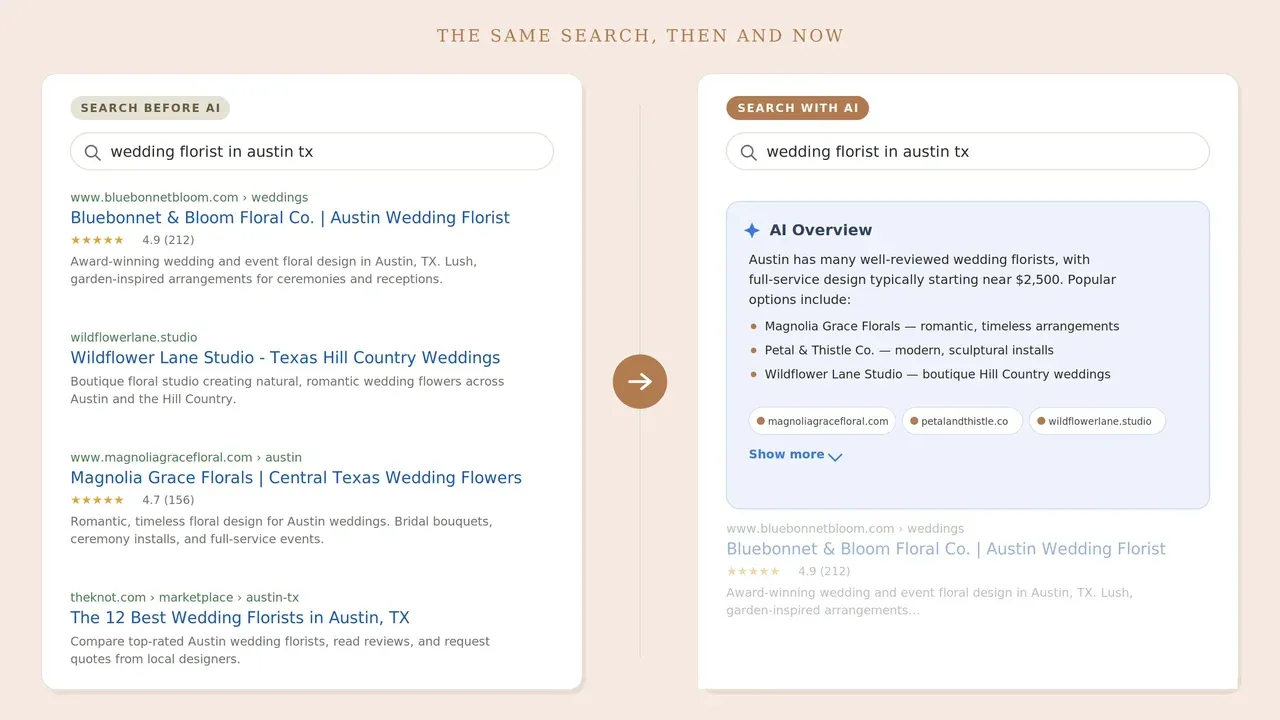
Brian Hummel, Co-Owner | Flowering Minds
It's not news to anybody that AI is transforming the way that humans interact with data and for florists, the way that AI is affecting internet search is meaningfully changing how and IF customers choose your business . For years, for a floristry business to be discovered, it meant ranking high on search engines (Google) so people would click through to their website. That still matters, but it is no longer the whole picture. Increasingly, people are turning directly to AI assistants (ChatGPT, Claude, Perplexity, Gemini) and these systems don't return a ranked list of websites the way a traditional search engine does; they generate a new, synthesized answer that is typically only a few sentences long, citing only a source or two. A query like "wedding florist in Austin TX" will likely generate an answer that doesn't include the same top ranking results as an organic Google search. Organic search, itself, is also beginning to integrate AI answers into its search results page. Google search now places an AI-generated answer box at the very top of many results, above the usual list of websites, so an answer appears before a searcher ever reaches a website. This matters for florists because the floristry services that customers choose (looking for a wedding florist in their city, same-day delivery nearby, the right florist for a destination wedding) may increasingly be determined by AI answers rather than organic search results, and whether or not your business is being mentioned in those answers obviously matters.
This is a fast-moving area, and it is worth being clear about what is settled and what is not. The shift itself is not in question; the data is clear and it is already changing how businesses get found. The tactics are evolving quickly, and a great deal of what is currently written about them is more confident than the evidence warrants. We are watching this closely, separating what genuinely works from what is noise, and we have begun integrating that understanding into what we teach at Flowering Minds. What follows is the fuller picture of what is happening and why it matters for your floral business.
Already a Flowering Minds member? Skip ahead to our "Adapting For AI Search" lesson inside the membership for concrete, actionable steps you can take today.
What actually changed about search?
For most of the last decade, a Google search returned a list of websites and the goal was simple: rank as high on that list as you could because higher rankings meant more clicks. We have noticed two things that have changed that.
The first is the AI Overview, the AI-generated answer box Google now places at the very top of the results for many searches, above the familiar website links. You do not turn it on; Google decides, query by query, whether to show one. As of 2026 it appears on roughly a quarter of all Google searches, and when it does, the top-ranked website loses somewhere between 58 and 61 percent of its clicks, according to studies from Ahrefs and Seer Interactive (two of the research firms that track SEO and search performance). You can still rank number one and lose most of your traffic, because the answer is now sitting above your placement in organic search results.
The second is that Google is no longer the only search box. People increasingly ask AI assistants like ChatGPT, Claude, Perplexity, or Google's own conversational AI Mode, which reply in a few sentences, name a source or two, and show no list of links at all. On these, searches routinely end with no click to any website; inside Google's AI Mode, by some measures, that happens around 93 percent of the time. Traffic to AI search tools grew roughly 43 percent in a single year, and Semrush, another of those research firms, projects AI search will overtake traditional search by 2028.
One distinction worth keeping straight: an AI Overview can appear on an ordinary search without you choosing it, while AI Mode is a separate, conversational experience a user has to switch into deliberately. So not every search shows an AI answer, but a large and growing share now do.
There is one phrase for the whole pattern: zero-click search. Around two thirds of all searches now end on the results page without customers evaluating website links and clicking through each to make their decision, as they would have with organic search. While the typical bride is not likely to decide on their wedding florist by accepting the few suggestions presented within AI answer, we would still be wise to look into what changes we can make to increase our odds of being mentioned within an AI answer for typical queries that target our services.
Why does AI search matter for florists?
It would be easy to assume this is a problem for big national websites, not for a flower shop or a wedding designer. The opposite is true, and the reason is specific to how people shop for flowers.
AI answers do not appear equally on every kind of search. They cluster on two kinds in particular, and buying flowers runs straight through both. The first is the informational question, the "how much," "what," and "which" searches people run while they are still deciding: a couple pricing out their wedding flowers, someone asking what blooms are in season for a fall event, a client trying to understand what a full-service florist includes. Those questions increasingly return an AI-written answer at the top of the page instead of a link to your site. The second is the local search. "Florist near me," "same-day flower delivery," and "wedding florist in my city" are the lifeblood of most floral businesses, and AI summaries are increasingly appearing on top of the map and local results those searches used to show plainly.
Not every florist is chasing the same customer, and that matters here, because it changes what "getting found" even means for you. If you run a retail shop, most of your visibility is local: the person nearby searching for same-day delivery, a sympathy arrangement, or a birthday bouquet, usually through a "florist near me" style search. If you focus on weddings and events, you are competing for the couples and planners in your region, the ones looking up a wedding florist in your city or asking what wedding flowers tend to run where they are getting married. But a growing number of designers are aiming wider: destination weddings for couples who could book anyone anywhere, national commercial and event accounts, or a retail line that ships across the country. That ambition means competing nationally, without the home-field cushion of a local map result to fall back on.
The shift reaches all of these, though not identically. For local work, AI summaries are increasingly sitting on top of the map results and the "near me" searches you depend on. For national ambitions the exposure is sharper, because the broad, high-budget searches ("best destination wedding florist," "who handles large-scale event florals") fall squarely into the categories where AI answers appear most and where almost no one clicks through to a website at all. The encouraging part is that the underlying move is the same at every level: becoming the specific, recognizable name the AI trusts enough to put in its answer, applied either to your region of the map or to the whole country, depending on how far you are reaching.
Does this mean your SEO work was wasted?
No. People are searching as much as ever. What is evolving is the path between the search and your business.
If you have put work into your on-page SEO (your page titles, your descriptions, your headings, the basic structure of your site) none of that is wasted. It still pays, and it is still the foundation everything else sits on. A well-built, well-optimized page is exactly what these AI systems read when they decide what to include in an answer, so the fundamentals have not gone anywhere. On-page SEO is part of what we teach inside the membership, and it remains the base that the newer, AI-focused work builds on top of. What is new is that a few additional focal points now sit on top of those fundamentals, aimed at a second goal.
That second goal is being named. The old objective was to rank, to sit high on the list of results. A new secondary objective is to be the business the AI answer actually names and links when it responds to your customer. Ranking still matters, because the AI usually composes its answer out of well-ranked pages. But ranking is now the means, and getting named is the payoff. And underneath the whole thing sits one idea: these systems are trying to point people to sources they can trust, so the businesses they name are, at bottom, the ones they read as credible and well-regarded. A florist the AI trusts enough to name captures the attention that used to go to the top link. A florist the AI cannot place, or cannot vouch for, simply disappears from the answer, however well the old-style ranking is going.
This is a better picture than "SEO is dead," because it means there is a clear, winnable game here. It is just a slightly different game than the one most florists are still playing.
What kind of content actually gets named by AI?
At this moment, I will describe the high-level picture rather than every granular detail, partly because the specifics are involved enough to need more than a few lines here, and partly because the right approach genuinely depends on your site and your goals.
Start from what these systems are trying to do: recommend sources they can trust. Everything else is a way of reading that trust. At the simplest level, they name content that is specific, checkable, and laid out clearly enough that a machine can pull it and credit you for it, because specific and verifiable reads as credible, while vague marketing language reads as noise and stays invisible to them. "The best florist around" gives an AI nothing it can quote or trust. A clear, factual statement that answers a real question, and makes plain who is saying it, is the kind of thing that gets picked up.
The deeper version of the same idea is recognition and reputation. These systems increasingly see the web as a set of real, named businesses and people, each with a known reputation and known connections, rather than a pile of keywords. There is a difference between a florist the system recognizes and trusts as a real, well-regarded name and one it can only see as a blur. And that trust is not built on your own website alone; it comes from being a genuinely credible, recognized presence that other trustworthy sources point to as well. For a local shop that looks like a strong, consistent reputation in your area; for a designer with national ambitions it looks like real authority in your niche. Either way, becoming that trusted, recognized name in your corner of the floral world is the closest thing there is to a core principle here. Earn genuine trust and recognition, and the citations tend to follow.
It helps to picture how one of these systems actually reaches its answer. Asked to recommend a good wedding florist, it does not simply scan a few pages and rank them. It gathers what it can piece together about each candidate from across the web: who they are, what they are known for, who founded them, which social profiles, directories, and press mentions line up with the same name, and which other credible sources point back to them. From all of that it assembles a kind of connected map of each business (an entity graph, in the technical language), then weighs how trustworthy and relevant each one looks before leaning toward the ones it can build the most trusted, corroborated picture of. A florist whose presence is thin, scattered, or inconsistent gives the system very little to go on. A florist whose name, story, specialties, and reputation line up cleanly everywhere it looks becomes an easy, safe one to recommend.
There is a lot here, and much of it is genuinely technical: the highest-leverage moves are the structural, behind-the-scenes signals that tell these systems who you are and why to trust you. One concrete example is schema markup, also called structured data: a small piece of code added to your website that states plain facts about your business (your name, location, hours, and services) in a format a machine can read directly instead of having to guess. Most florist websites either do not have it or have it incomplete, and you can check your own site for free using Google's Rich Results Test. Inside the membership we walk through exactly how to check for it, how to add it, and six other concrete steps like it. The principles are well established and they are not going anywhere: be specific, be verifiable, be a recognizable and well-corroborated name.
So what should a florist do now?
We can no longer assume that a strong Google (organic search) ranking is the finish line. If this is the first time you are considering how AI affects your businesses visibility to prosepctive customers, you are not behind. You are ahead of almost everyone. Most florists have likely not registered this yet, which means the ones who move early hold a real, lasting edge while the rest catch up.
After that comes the harder part: acting on it. The understanding is what this article is for. The acting is where the real work lives. Some of it is technical and will take either expertise or the right tools. Some of it is not technical at all, and can be started immediately by anyone willing to do it. And some of what the industry is currently recommending will turn out to be noise. Sorting the signal from the noise is the work we are doing, and we are beginning to fold what we learn into the membership. The florists who start paying attention now, while most of the field has not looked up yet, will be the ones positioned to move quickly. The ones who wait will be reacting to a change their competitors already absorbed.
Inside Flowering Minds, we are getting started with the basics: checking whether your own site already has the technical signals these systems look for, tightening the everyday details (your Google Business Profile, your reviews, a real page for each service you offer) that feed both traditional and AI-driven search alike, and building from there as we learn what actually moves the needle. None of it requires a large budget or a developer on staff. It requires knowing where to look first.
Already a member? Jump straight to our Adapting For AI Search lesson for the actionable next steps and downloadable templates.
If you are still working on the basics, check out our Step-By-Step Guide To Setting Up A Floral Business.
Learn more about the Flowering Minds membership.
Have a question about how it works? See our frequently asked questions.
Common questions about AI search for florists
Is SEO still worth it for florists?
Yes. Search demand has not declined; the path from a search to your website has changed. Ranking well still matters and remains the foundation, but the newer goal is to be cited as a source inside AI-generated answers, which is where a growing share of searchers now get their information.
How does AI decide which florist to recommend?
Ranking is your position in the traditional list of links. Being cited means an AI-generated answer (in a Google AI Overview, ChatGPT, or Perplexity) names or links your business as a source. As more searches are answered directly on the screen, being cited is increasingly what determines whether a searcher discovers you at all.
Will AI search reduce my flower shop's website traffic?
For many searches, yes; fewer searchers will click through to a website, because the answer is delivered on the results page. The offset is that the visitors who do arrive, and the citations that name your brand, tend to be higher intent. The strategic response is to optimize for visibility and citation, not clicks alone.
How can a florist show up in AI search results?
At a high level, by becoming a trusted, recognized name in your corner of floristry. In practice that means publishing specific, verifiable content and building the kind of genuine reputation that both AI systems and the sources they draw on treat as credible. The detailed, technical execution is involved, and it is an area florists will increasingly need to understand as AI search grows.